Taking Profit — The Most Important Skill in Trading and Investing
Perhaps it takes losing a lot of money and time before a trader finally realises that taking profit is one of the most important skills in trading. I also lost many years before realising that, and thanks to it I have now improved my trading results a great deal.
And I believe that what I am about to share is very rarely mentioned in books about trading. And it also does not appear in tutorial videos about trading and investing.
A few years ago, I read 2 sayings that only now do I fully understand the meaning of.
The first saying is: Money is only real when you take profit.
And the second saying is: Success in trading comes much more from how to exit a trade than from how to enter a trade.
So why is exiting a trade more important than entering a trade?
Let us go into an example below to answer that question.
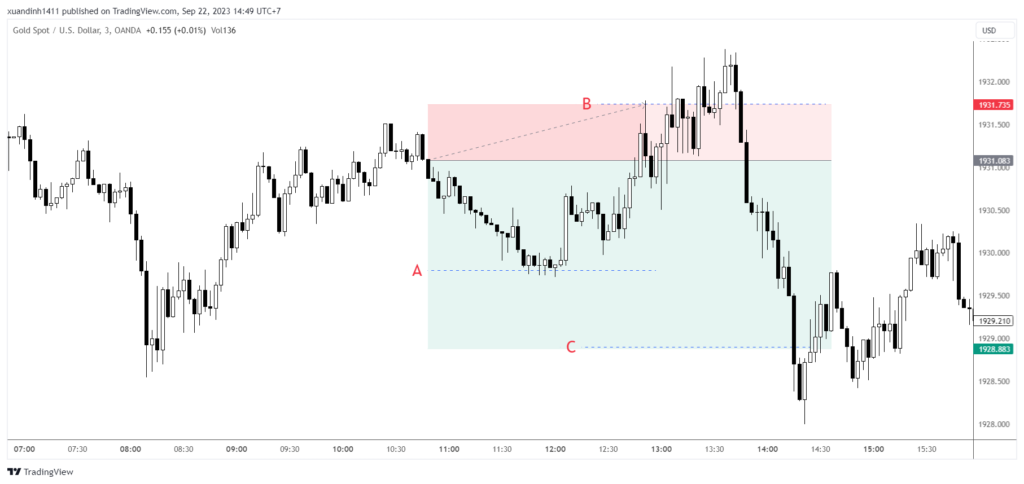
Suppose we enter a sell trade in a downtrend when price pulls back. Usually you would place the stop loss somewhere above the previous high. We place the take profit at the area of the previous low. The RR ratio in this case is 3:1 (profit is 3 times the risk). Right after entering the trade, price moves downward and you dream of a winning trade.
In your opinion, is this a good trade?
Price continues to fall, then it shows signs of slowing down; a few traders will move the stop loss to the entry position. Others rush to take profit at A. Some other traders do nothing at all.
Price returns to the entry position; those who moved their SL exit with no profit at all. Traders who do not exit feel like they are on fire; price sweeps through the stop loss point B.
But after that, price falls in one go, running through the take profit point C as originally expected. But there is not a single bit of profit, or even a loss. The trader should have had a perfect trade and brought home a pile of profit. But somehow the trader turned a good trade into a loss and watched that trade move without them.
ANOTHER TRADING EXAMPLE ABOUT TAKING PROFIT IN TRADING
We are human, and falling into that situation, most of us feel disappointed. Sometimes powerless and indignant because the market is teasing us. And some traders say that if only they had placed the stop loss farther away, if only they had taken profit earlier, perhaps everything would have been different.
Like the trade above, we expect an RR ratio of 4:1 for this trade. Everything is very beautiful; price moves to point A and a liquidity sweep appears. Some people will exit at A, others will move the stop loss to the entry position.
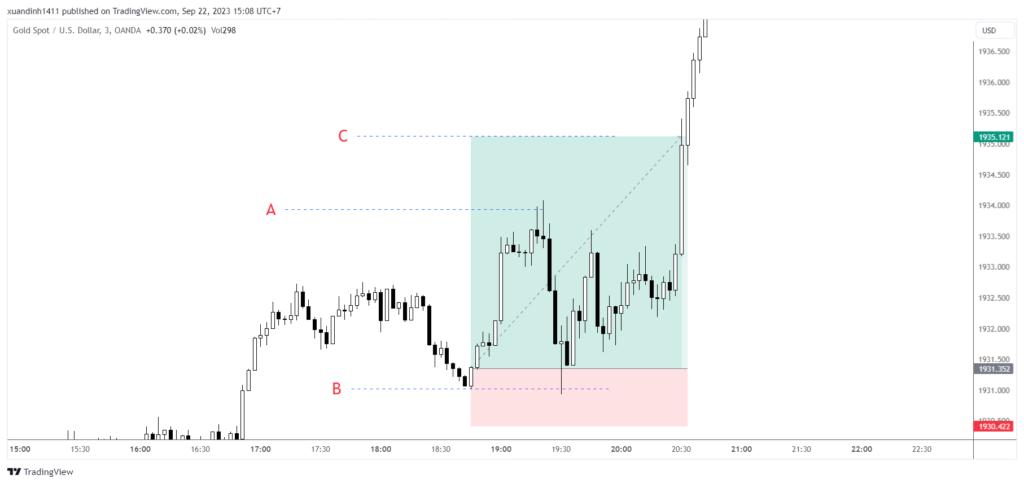
Price starts to plunge straight back to the entry position and plunges through the previous low B. Many people will immediately decide to cut the loss and accept a small loss.
However, price immediately turns around and goes up to touch the original take profit point. At this point, the people who exited at the entry position or at low B are the saddest and most disappointed traders. The people who took profit at C and A are the happy traders.
But no, price continues to go up farther than the take profit point the trader expected. At this point, in the trader's mind there is regret about a tasty opportunity that slipped away. Regardless of whether the trader has a profit or has nothing from this trade.
Because traders are human, and humans all have emotions, everyone has GREED, ANGER and DELUSION.
WHAT DO WE LEARN FROM THE 2 TRADES ABOVE
I think that you have gone through both situations above, and many other situations during trading. And perhaps it is precisely those emotions that make you not follow your trades, chase trades or take revenge on the market. And the result of that is quite disastrous: you lose a lot of money or blow your account.
From the same entry position, there will be people who are pushed out of the market in different ways. So is there an optimal way in this case? The answer is NO.
What do we learn from the example above? This is what I observe:
- In each trade, profit or loss comes from how we place our SL and TP. That is to say, it depends on exiting the trade. With the same entry position, we have many possibilities for exiting a trade. A few make a profit, a few break even and a few lose. That is why I say that although identifying a high-probability opportunity to enter a trade is very important, even more important is that we focus on exiting the trade.
- We cannot know which exit strategy will give the best profit until that trade is executed. Sometimes a short stop loss is good, sometimes a wide stop loss… Sometimes placing the profit at one price level is good, sometimes a trailing stop is better.
And precisely because of those things, I built for myself 4 principles about taking profit.
PRINCIPLES ABOUT TAKING PROFIT
Principle No. 1: Fixed rules are not effective.
I will tell you a story. There was a seasoned trader who invited a technical analyst to teach him. The analyst explained about support and resistance levels. And affirmed that when price goes to those levels, price will reverse. One day, the seasoned trader called that young man over to sit with him to trade. When price moved to a support level.
He turned and asked: young man! Did you say that when price goes here it will turn back, right? The young man nodded; the seasoned trader asked again, are you sure! Then he entered a large short sell order for the stock. Price broke deep down through support to the young man's astonishment. Because he was always proud of his analytical ability.
This story only wants to say that the market moves because of the decisions of countless investors and traders. And there are thousands, tens or hundreds of thousands of traders participating in the market. So we cannot know what they will do and when they will do it. Therefore, fixed rules are not effective in the long term.
Principle No. 2: You will never have the perfect exit strategy
Because, as I said, the market fluctuates following no rules at all. And we also do not have any perfect strategy for all of our trades.
And that strategy is only suitable for 1 or a few trades; it is not effective for all of your trades. Because, simply, anything can happen in the market, at any time.
But do not worry: in another article I will have a few suggestions for you to refer to regarding exit strategies.
Principle No. 3: The exit strategy must suit your trading psychology
I think this is the most important part of an exit strategy. Do not try to maximise profit. Instead, optimise the compatibility of the exit strategy with your own psychology.
After a trade, have you ever felt regret because you took profit too early? Have you ever felt disappointed that you did not take profit at a good price level, only for price to come back and for the profit to be almost nothing left? And worse is having a profit and not taking it, only to end up losing.
After each such trade, your psychology will fluctuate and you will blame yourself. I am sure most of us fall into this state. And then that psychology will pull along emotions of anger at the market. And we enter trades as if taking revenge on the market; that action cannot be controlled.
It is no different from when we are on the road and we try to avoid a fierce dog. Then it rushes in and bites us once. Immediately, anger makes us throw away our fear, and rush into a brawl with the fierce dog. The financial market, and especially the Forex or crypto market, is much more dangerous than that. You may have to leave the market by blowing your account.
Therefore, try to harmonise your own psychology with your exit strategy.
Principle No. 4: Defence is better than attack.
This can be seen most clearly in football. Before we think about scoring a goal, the most important thing is not to concede a goal. Because, simply, if we concede, we must strive to equalise before thinking about winning. Trading is exactly the same: if we lose money, sooner or later we will also be kicked out of the game.
The Forex market is the playground of masterminds all over the globe. Sometimes you win, many times you lose, but in the end ask yourself a question. Do you want to become a successful trader or an ordinary trader? I think that, in any profession or field, money flows into the pockets of professionals. The road to becoming a professional trader is really not easy. Learn every day, and I think TRADING IS A JOURNEY, NOT A DESTINATION.
5/5 - (3 votes)
Read structure 10x faster with JUKA
JUKA maps SMC structure — swings, BOS, CHoCH and inducement zones — automatically on any TradingView chart. No more hand-drawing structure for hours.
Get JUKA — $150