ICT Part 5: What Is Displacement and Entry Strategies with Displacement
What is Displacement in ICT?
A Displacement Move is the phenomenon of price being pushed strongly out of its current price zone, usually due to a large flow of money entering the market with strong conviction.
Displacement helps identify the direction of Smart Money.
 What is Displacement?
Characteristics of displacement:
- Takes place quickly and strongly.
- Leaves Fair Value Gaps/Liquidity Voids behind.
- Leads to a change in structure.
How to identify Displacement
- Look for large candles that close beyond an old high/low.
- If price breaks a high/low but immediately returns into the old zone → that is No displacement.
- If there is a large candle force closing outside the old high/low → that is displacement.
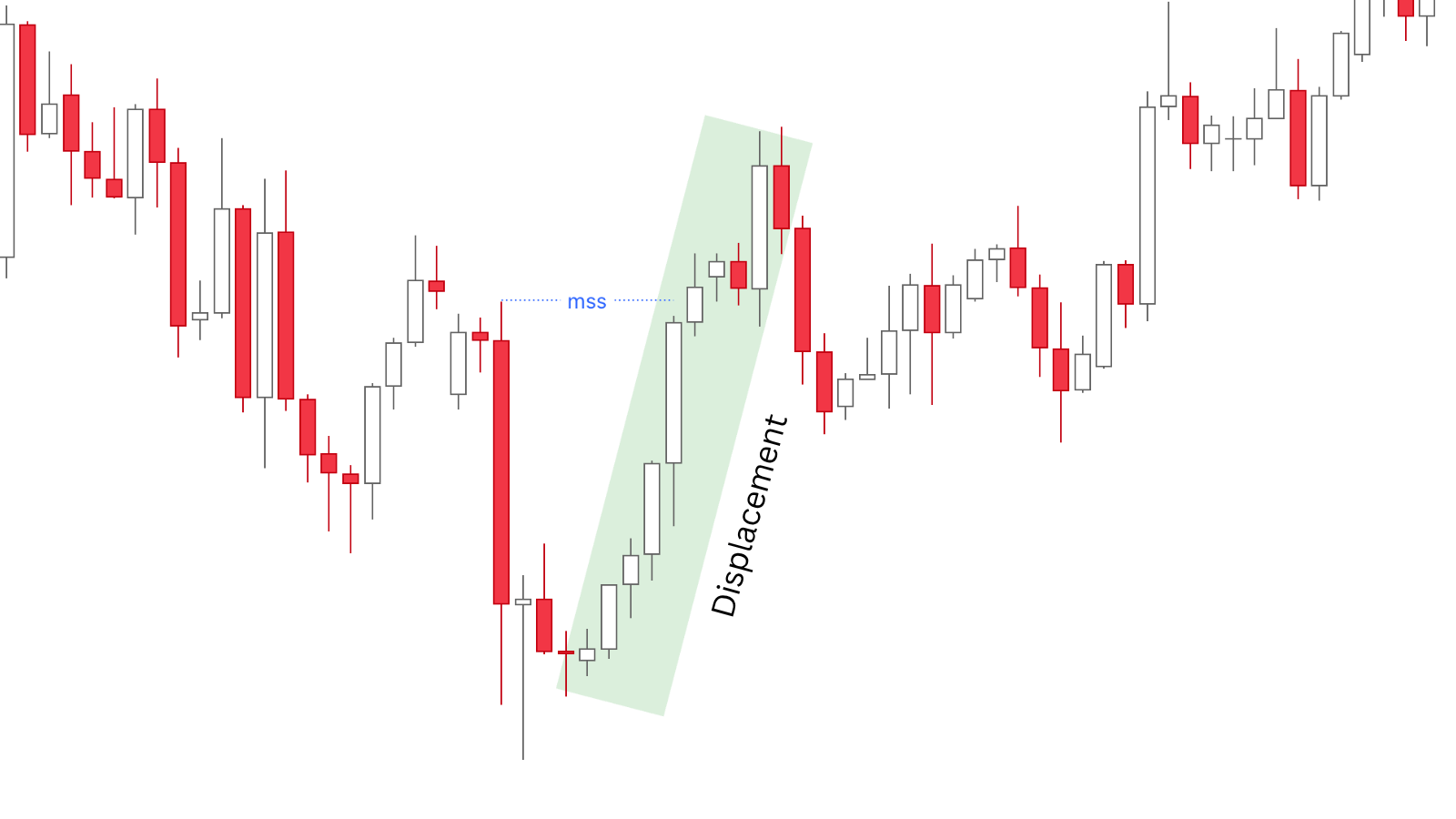 Example of bullish Displacement
The role of Displacement in trading
After finishing identifying the structure, a clearly appearing Displacement is an important signal for making an entry decision.
With a downtrend:
- Short order: displacement appears, breaking through LRLR (old low).
- Long order: when displacement appears but fails to break the low, it can be a bullish reversal signal.
Similarly with an uptrend:
- Long order: displacement appears, breaking through LRLR (old high).
- Short order: when displacement appears but fails to break the high, this is a bearish reversal signal.
What is No Displacement?
No Displacement (or Lack of Displacement) is the situation where there is no large, decisive candle closing beyond the nearest high or low, or it is a failed Displacement.
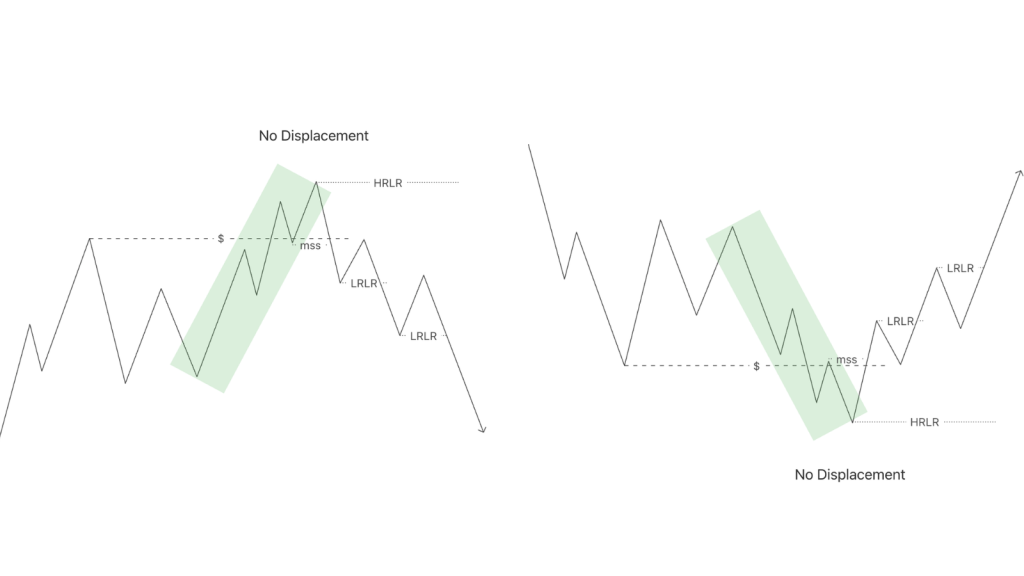 What is No Displacement?
Lack of Displacement occurs when there is a lack of liquidity from both sides, and it usually appears in a counter-trend corrective wave.
How to identify No Displacement
In an uptrend:
- If price takes a low without a large bearish candle. This may be No displacement.
- If price takes a low with a large bearish candle, but price does not continue and quickly returns, then this is precisely a failed Displacement and converts into No displacement.
- If price cannot take the low, that shows the uptrend is still intact. This can also be considered No Displacement.
Similarly with a downtrend.
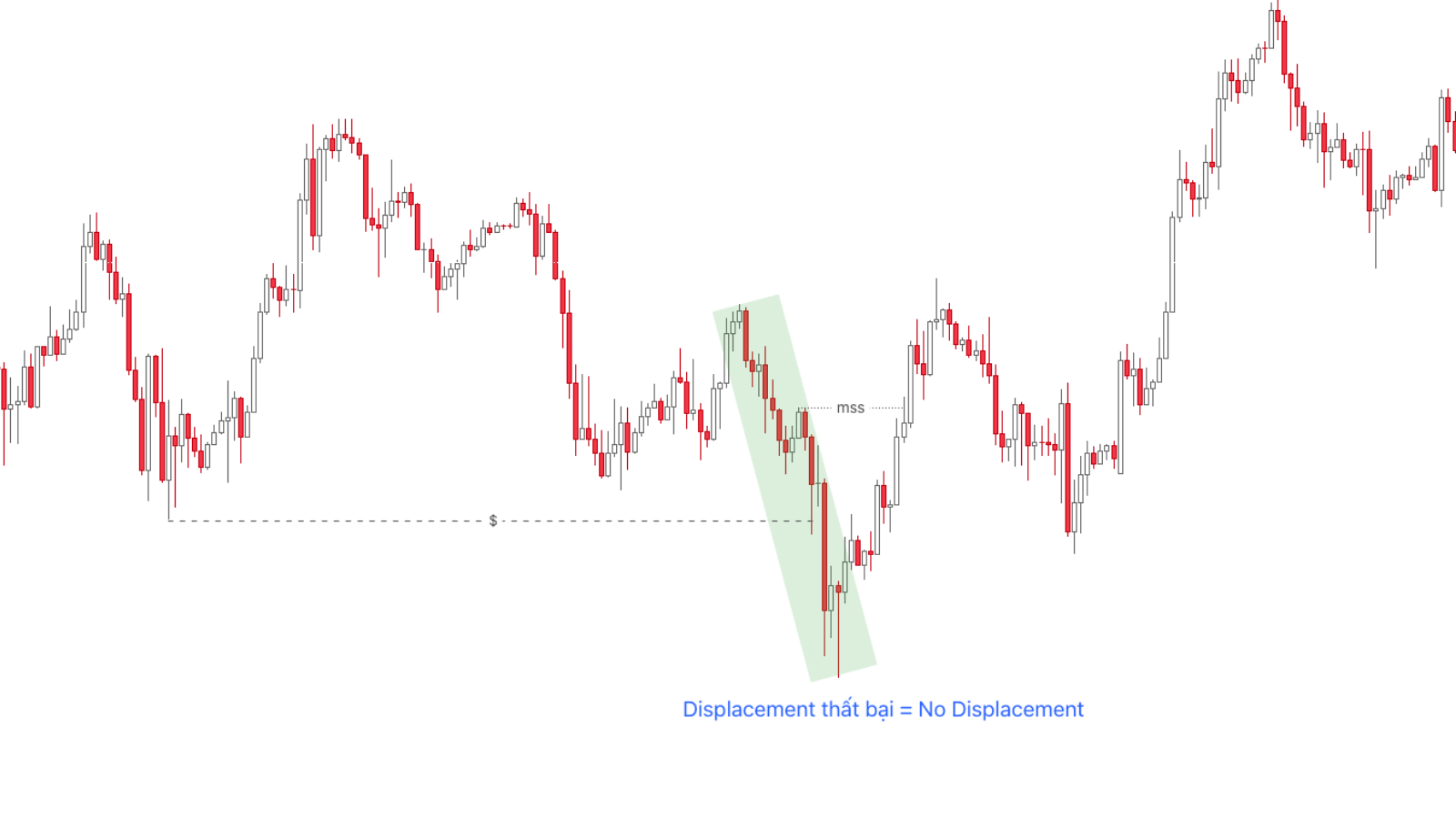 A failed Displacement is No Displacement
Displacement is a successful breakout with a strong move, while No Displacement is a false breakout (Fakeout).
Waiting for a Displacement or No displacement before executing a trade is very important because this will help traders track Smart Money and join the market at the right time.
Trading strategy with Displacement
Displacement is an observation factor that helps traders track the direction of Smart Money; it is not an entry model.
In this section we will combine Displacement + FVG + timing to look for a suitable entry time.
Displacement + Bearish FVG
Price breaks old highs and then quickly reverses and falls strongly.
 Displacement + Bearish FVG Setup
The steps are as follows:
- Wait for Displacement to appear and take liquidity from a high.
- This Displacement fails and becomes No Displacement.
- An FVG forms within the range of the Displacement.
- Structure reverses (MSS) from up to down.
- Enter at the FVG in confluence with a PD Array.
Example of the Displacement + Bearish FVG setup on the GBPUSD pair:
 Displacement + Bearish Liquidity Void
Displacement + Bullish FVG
Price breaks an old low and then quickly reverses and rises strongly.
 Displacement + Bullish FVG
The setup consists of these steps:
- Wait for Displacement to appear and take liquidity from a low.
- This Displacement fails and becomes No Displacement.
- An FVG forms within the range of the Displacement.
- Structure reverses (MSS) from down to up.
- Enter at the FVG in confluence with a PD Array.
Example of the Displacement + Bullish FVG setup on ETH/USDT:
 Displacement + Bullish FVG
Combining the time factor with Displacement
If you combine the time factor, the win rate will increase significantly.
The NYO (New York Open) mark is 8:30 AM ET = 7:30 PM Vietnam time in summer, and = 8:30 PM Vietnam time in winter.
To know NYO accurately on TradingView, you should set the time zone to New York (UTC -4). TradingView automatically updates the time by season, so you only need to select the correct time zone, without worrying about changing it manually by season.
- NYO is important because this is the time when the news embargo is lifted (News Embargo Lifts).
- Observe the potential liquidity zones where price can sweep liquidity; a stop hunt can occur at this time mark.
 Displacement + FVG + NYO
In the example in the figure above, after NYO, price created Displacement taking liquidity but quickly failed, returned, and created an MSS.
The suitable entry point is a Bullish FVG in the Discount Array zone.
Thus, Trading Hub 3.0 has completed the 5 PD Array parts; in the following parts we will go deeper into timing, the most important factor of the ICT method.
5/5 - (6 votes)
Read structure 10x faster with JUKA
JUKA maps SMC structure — swings, BOS, CHoCH and inducement zones — automatically on any TradingView chart. No more hand-drawing structure for hours.
Get JUKA — $150