Trading Hub 3.0 (Part 5): What is an Order Block (OB) and How to Enter Trades – True SMC
An Order Block (OB) is where Smart Traders enter Buy or Sell trades. The Order Block is an important part of the Smart Money Concept (SMC) method.
In this part, we will learn: What is an Order Block? What is a tapped Order Block? How to identify an Order Block, and where should we use an Order Block?
What is an Order Block in SMC?
An Order Block is the last selling candle before price rises in an uptrend (the candle color does not matter); we can accept the risk of placing a buy order by identifying an OB that marks bullish momentum, and if price later returns to touch that OB (we call that tapping / mitigation) we can place a Buy trade there.
Similarly with a downtrend, when price breaks structure — you could say BOS or CHoCH — we must identify the OB as the last buying candle before price falls. For an entry, we need to wait for price to return to tap that OB and enter a trade according to the plan.
Identifying an OB is an interesting and very important task; there are many OBs appearing in one price movement and we need to identify which OBs are valid and which are not.
Video guide on Order Blocks - SMC Trading Hub
How to identify an Order Block
According to the Trading Hub 3.0 material, to mark any Bullish / Bearish Order Block, there must be an Imbalance and price must sweep the high/low of the previous candle (sweep liquidity) to confirm the Order Block.
Note: Order Blocks come from Order Flow, so if the OF has been tapped, the market will not need to tap the OB anymore. If the entire OF has been tapped, we focus on finding an untapped OB.
Bullish Order Block
In an uptrend, the last candle that sweeps through the low of the previous candle before price rises and creates an Imbalance is called an Order Block.
OB and IMB go together for a high win probability.
When price returns to tap the OB we can enter a Buy trade on the LTF.
When price sweeps liquidity but does not create an IMB, we can look for an OB at the following candles; the first candle that creates an IMB will be called the OB.
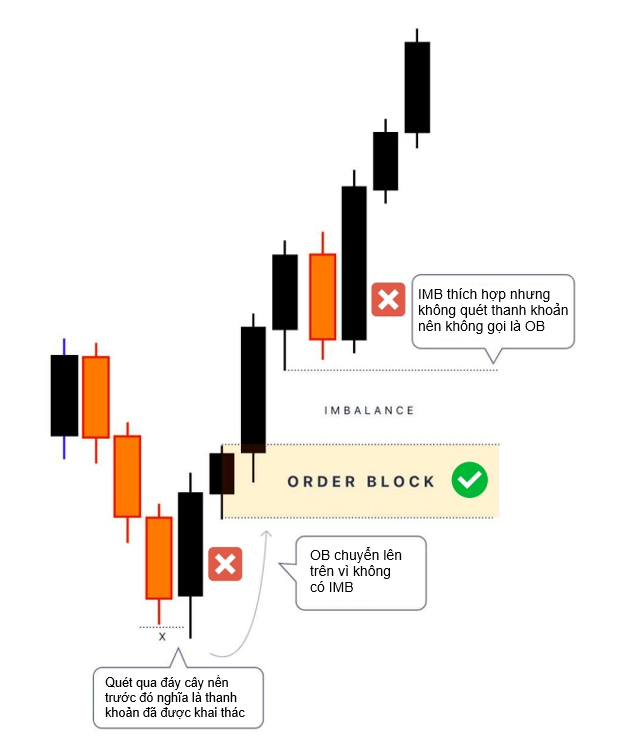 Bullish Order Block (figure 1)
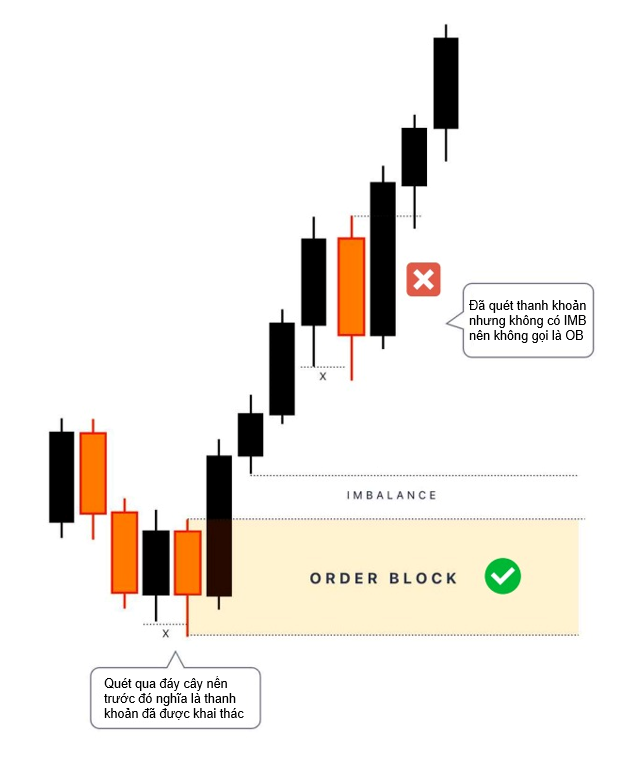 Bullish Order Block (figure 2)
Bearish Order Block
In a downtrend, the candle that sweeps through the high of the previous candle and creates an Imbalance is called an Order Block.
When price returns to tap the OB, we can enter a Sell trade on the LTF.
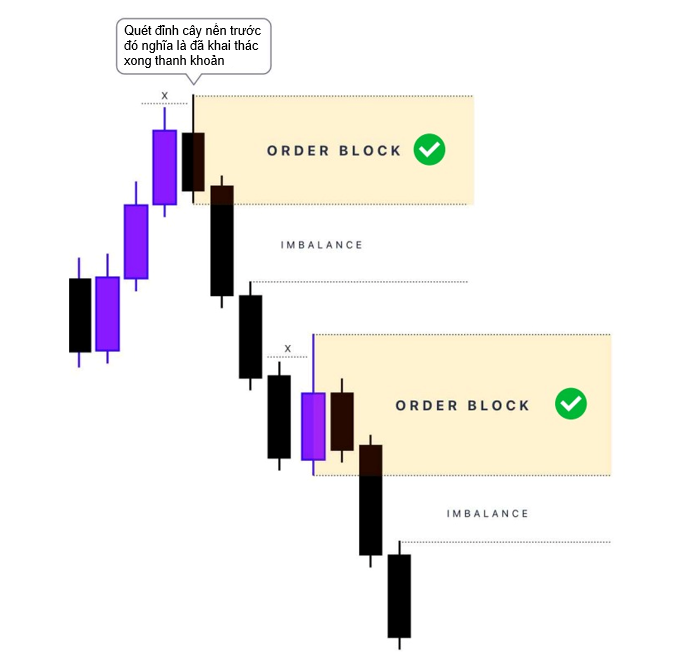 Bearish Order Block (figure 1)
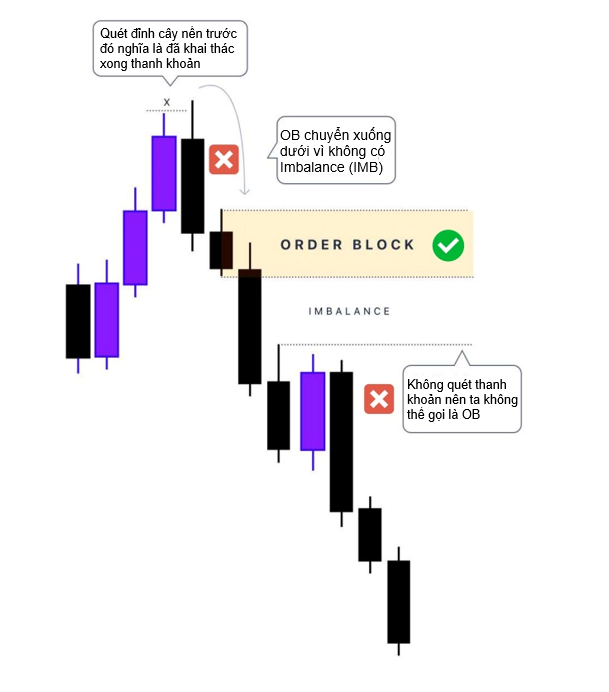 Bearish Order Block (figure 2)
An Order Block formed at a high or a low is called an Extreme Order Block.
If an OB has been tapped, we call it an invalid OB and do not use it anymore.
Price often reacts from OBs at decision price areas or Extreme OBs. An Extreme OB gives a higher probability than ordinary OBs.
In the case where an OB does not have a valid IMB, we can take the candle wick as the OB as long as that wick has not been tapped.
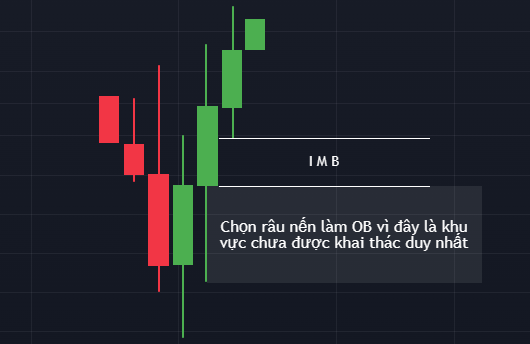 Choosing a candle wick as an unmitigated OB
OBs located within an OF will give a higher probability than OBs that do not belong to an OF.
Note: In the Trading Hub 2.0 material, the definition of an OB does not require sweeping the liquidity of the previous candle, only creating an IMB; this will affect how we set up entries.
Order Block examples
Now you can understand more clearly how everything actually works with Order Blocks; to mark an OB there needs to be a suitable IMB and a liquidity sweep.
Let us look at the real examples below to understand OBs more clearly.
 Example of a Bullish OB
  Example of a Bearish OB
Note: You should enter trades following the market's main trend; do not mark OBs to enter trades in both directions. When the market is bullish, only look for buy trades, and when the market is bearish, only look for sell trades.
An Order Block is not SMC; an Order Block is only a streamlined version of Order Flow that lets us make buy or sell decisions with high probability. If price touches the OF and gives a reversal or continuation signal, we can still enter a trade with the OF without waiting for an OB.
Read and re-watch the Order Block video guide many times to understand its nature.
Entering trades with an Order Block
How to enter trades with an OB based on liquidity
We can enter a trade directly when price returns to tap the OB according to the following 3 scenarios:
- Method 1: If price breaks structure (BOS) and has not swept liquidity beforehand, we need to wait for price to return, break through IDM, then tap the OB to enter a trade.
- Method 2: If price has swept liquidity beforehand, we can enter a trade as soon as price returns to tap the OB without waiting for IDM.
- Method 3: If price creates an Order Block with a wick that sweeps the liquidity of the previous candle, and then sweeps the liquidity below, we can enter a trade when price taps the OB without needing IDM.
 Entering a trade with OB method 1 with IDM
  Entering a trade with OB method 2, liquidity sweep without IDM
  Entering a trade with OB method 3: taking liquidity afterwards without IDM
Compared to OF, entering a trade at an OB will have a lower probability. If an OB is located within a tapped OF, price may not return to tap that OB anymore.
In the example below, the first and second OBs are located within an OF that has been tapped, so price only returned to tap the third OB and then went straight down.

To ensure a high win rate and RR, we should switch to the LTF to enter trades with the SCOB setup; please read Part 10 of this series.
In the following parts of this Trading Hub 3.0 material we will discuss detailed entry models.
Rate this article
Read structure 10x faster with JUKA
JUKA maps SMC structure — swings, BOS, CHoCH and inducement zones — automatically on any TradingView chart. No more hand-drawing structure for hours.
Get JUKA — $150